
We Need a Hero
Ada Yonath and the Jewish identity war
Uriya Shavit
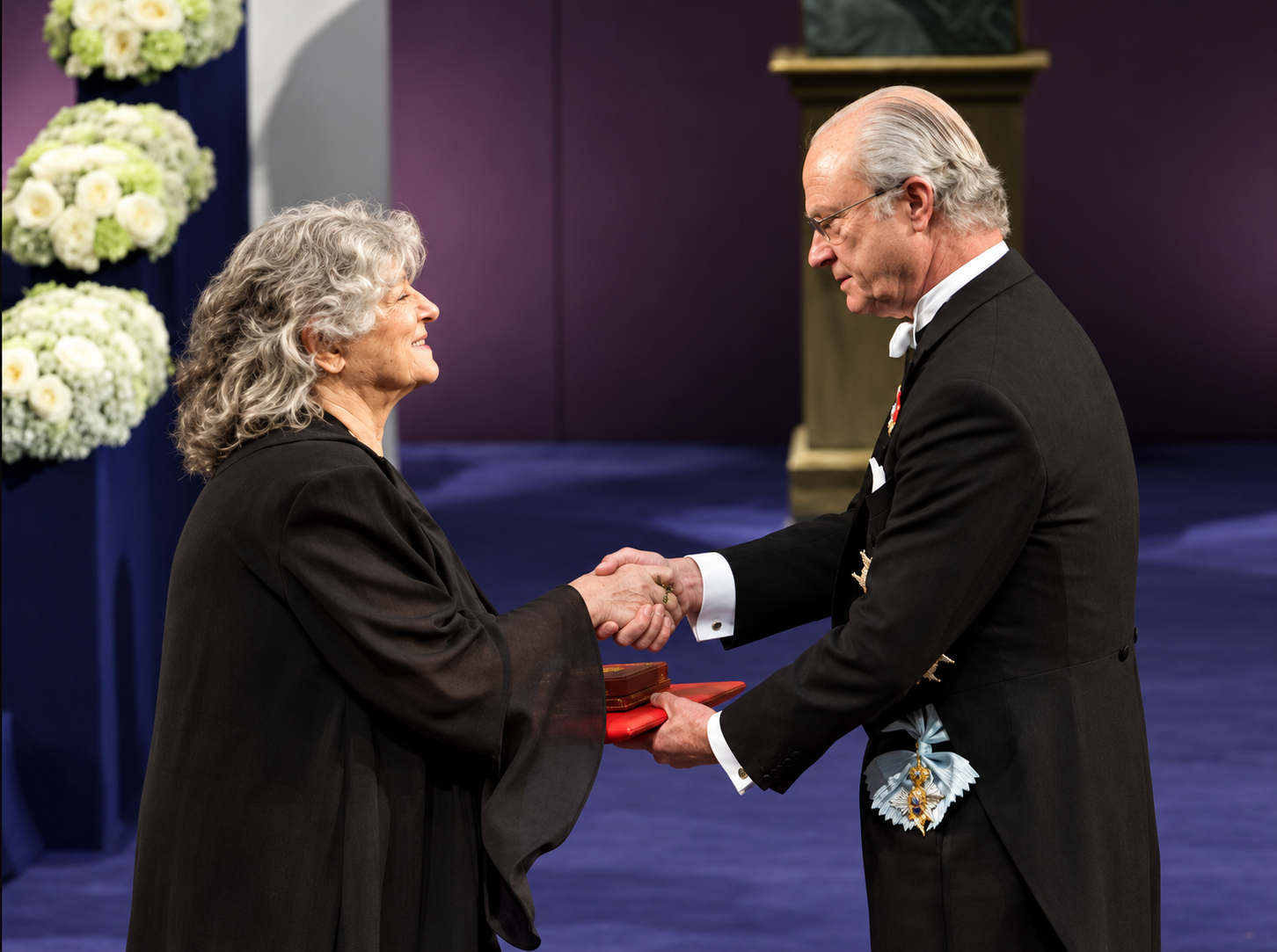
Here are some things that did not happen and should have happened following the death in late August of Prof. Ada Yonath, a crystallographer from the Weizmann Institute and the first Israeli woman – and one of the few women in general – to win a Nobel Prize in science.
The main television news networks did not interrupt their regular programs nor dedicate part of their evening broadcasts to her life and achievements.
The prime minister did not issue an inspiring statement of condolence that celebrates Israel’s scientific excellence.
A state funeral or service attended by dozens of thousands, as when Torah sages die, was not held, and a national day of mourning was not declared.
We should not be too easy on ourselves as to why none of this happened.
It is not because we are living in the age of shallowness and commercialism. Yonath’s biography was the stuff on which reality shows thrive. A young, curious girl from a modest background, who against all odds makes it to the very top in what is still very much a men’s world, and a rather vicious one at times.
It is also not because Yonath belonged to some academic ivory tower that is detached from the public. The basics of her contribution can be relatively easily communicated and have had a positive impact on the actual lives of actual people.
She brought honor and credit to Israel as few contemporaries did. There is a simple test to know whether an Israeli achievement on the world stage actually advances the standing of the country: ask yourself whether you would know about the same achievement had a non-Israeli accomplished it? Nobel Prize laureates are homepage and front-page news worldwide. The vast majority of the winners of the 1,044 medals awarded in the Summer Olympics are not.
It is also not because Yonath was a leftist and anti-Netanyahu activist (I was always curious what brought her to Uri Avneri’s Friday lunch parliament. My guess is that it wasn’t just politics; perhaps revolutionaries feel comfortable together). To act with such pettiness is typical of Netanyahu’s declining years and reign, but so is gross negligence.
Simply put, the reason why the death of Ada Yonath was not a national event is that it was not recognized as a national event by any political or cultural stream.
This is a pity.
It is a pity because the deterioration of Israeli elementary and high school education does not result primarily from a budget shortage, but from the decline of hard work and class discipline. A good deal of chutzpah and defiant spirits are what made Israel the start-up nation that it is, but these would have been meaningless without solid academic foundations achieved through demanding scholastic upbringing, and the Yonath story could have served as a reminder of that inconvenient truth.
It is a pity also because Yonath – and the other Israeli Nobel Prize winners – offer the Israeli majority something that it badly needs: identity.
The current brutal and crucial election campaign is, in the broadest sense, a struggle between two types and visions of Judaism. One is the modern, which also includes many observant Jews (and not a few supporters of the coalition), and which understands Zionism as a means to normalize Jewish national existence. Another is the medieval, which reincarnates Jewish texts and traditions in grotesque and self-destructive chauvinistic or parasitic forms.
In the battle between the two, the moderns have crucial advantages. They are the majority, albeit a rapidly shrinking one, and the economy and technological edge of the country almost entirely depend on their contributions. They lack, however, a clear definition of the modern identity that they so eagerly defend. Drawing on Herzl, Ben Gurion and others, the existing definitions tend to be either cyclical or shallow (a Jew is a Jew; a Jew is someone that antisemites define as a Jew), or apologetic and lacking (a Jew is someone who preserves some of the traditions that his or her great-grandparents used to observe). Worse, the definitions often tend not to be, as if the question can be avoided.
The majority of modern Jews in Israel know what their Jewish identity is not but cannot offer a coherent statement about what it is. Hence their lack of confidence, sense of rootlessness, fear that all is doomed.
Approximately one quarter of Nobel Prize winners in the sciences are Jewish, including the greatest of them all. Modern Jews have contributed to science and human advancement more than 100 times more than their share in humanity and more than any other people on the face of the earth. The per capita wins of Israelis rank their country at the top of the international list of Nobel Prize laureates. Israel is a recognized hub for innovation and scientific excellence. It may not have come into existence had it not been for the scientific genius of its first President, Chaim Weizmann, and his acumen in leveraging that excellence politically.
Taking pride in this heritage and present and making its cultivation a national cause cannot be a standalone identity definer. Yet it can be part of the construction of a positivist and endurable modern Jewish-Israeli identity. A piece of the puzzle, a start. Israelis who don’t weep when their science greats die may end up weeping for a lost state.