
Essay: The Fading Voice of Buckley
Last fall, the confidence of conservative American Jews that their political home is safe was repeatedly undermined. On September 10, 2025, hours after the murder of Charlie Kirk, the co-founder of the conservative student organization Turning Point USA,[1] social media filled with claims blaming Israel, the Mossad, “the Zionists,” or nameless “globalists” – a codename for conspiring Jews – for the crime. The phrase “Israel killed Charlie Kirk” proliferated across X.[2]
Among the pro-Trump activists who advanced such narratives was the popular right-wing podcaster and conspiracy theorist Candace Owens. She suggested Jewish figures had sought to silence Kirk because he was going to abandon his pro-Israel stances and move Turning Point USA away from supporting Israel.[3]
Owens was careful not to declare outright that Israel killed Kirk; that work was done through implication. “I’m not trying to mutter darkly or imply anything,” she said at one point, before naming Prime Minister Benjamin Netanyahu as a leading “liar” and asserting that “there are many liars out there trying […] to distort the truth, a truth that I know and can prove.”[4] She tried to deflect accusations of hating Israel and Jews, claiming she had never been “an Israel hater. Obviously, I’m not an antisemite,” and insisting that her insinuations were not “just about Israel.” Yet she named no other countries but Israel and no other politicians but Netanyahu.[5]
Following the assassination of Kirk, Tucker Carlson’s memorial broadcast lingered on the insinuation that “powerful people” wanted him dead. Carlson is one of the most influential media personalities in the MAGA movement and lobbied for Donald Trump in his 2024 campaign’s final mega-event.
Law enforcement investigations pointed toward a lone-wolf, radicalized young man as the killer. That mattered little to Carlson. Without foundation, he stated: “I can just sort of picture the scene in a lamp-lit room with a bunch of guys sitting around eating hummus, thinking about what to do about this guy telling the truth about us. We must make him stop talking. And there’s always one guy with the bright idea, and I could just hear him say, ‘I’ve got an idea. Why don’t we just kill him? That’ll shut him up.’”[6]
Carlson’s insinuations appeared on fringe social media accounts remixed with Stars of David and Israeli screenshots. He did not blame Jews explicitly for the murder, yet his conspiratorial style surfaced in an environment in which antisemitic inference is easy for the audience, a fact he was aware of all too well and which did not seem to bother him.[7]
On October 14, Politico reported on almost 3,000 pages of leaked Telegram chats, spanning a seven-month period, by leaders of Young Republicans chapters across the United States that contained explicitly racist and antisemitic slurs. It turned out that for certain twenty-something Republicans, references to African-Americans as monkeys, praise for Adolf Hitler, and a desire to see political rivals sent to the gas chambers were a joke (that is, at best, a joke). Other Young Republicans were indifferent to such rhetoric.[8]
A day later, Politico reported that a modified American flag, containing a swastika, was pinned to a cubicle wall in the office of Congressman David Taylor, a Republican from Ohio.[9]
The response of several Republican national leaders to the Telegram scandal was swift and unequivocal. Several Young Republicans chapters were disbanded. Several young activists were forced to resign. Yet that response was far from uniform. Vice President J.D. Vance, for example, shamefully dismissed the gravity of the scandal by saying that “kids do stupid things, especially young boys.”[10]
None of the Republicans involved was a kid.
Yet another shock came in late October when Carlson hosted the antisemite streamer Nick Fuentes for a long, almost convivial interview. A Christian nationalist and long-time Holocaust denier, who, despite his racist views, was hosted in 2022 by Donald Trump in Mar-a-Lago, Fuentes combines adolescent trolling with Holocaust denial, casual racism, misogyny, open admiration for Nazi Germany, and obsessive hostility toward Jews. He has been actively trying to infiltrate and undermine mainstream conservative institutions and influence the conservative movement’s rightward shift through his America First platform, becoming ever more openly hostile toward Jews in the process.[11]
In the kind of blunt distillation that travels online precisely because it is blunt, Fuentes stated in March 2025: “Jews are running society.” He also stated: “Women need to shut the fuck up, Blacks need to be imprisoned for the most part, and we would live in paradise. It’s that simple.”[12]
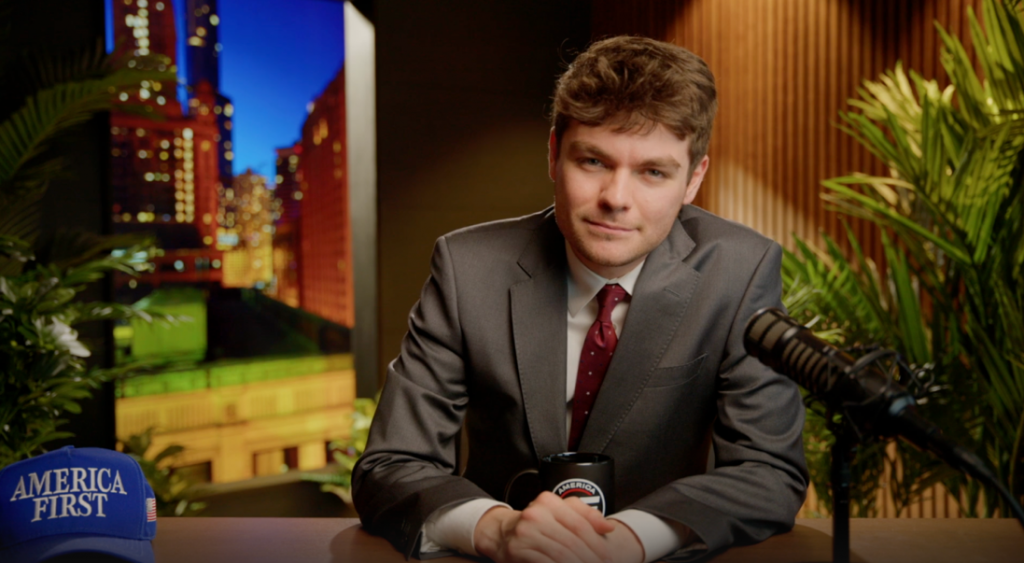
In video remarks defending Carlson after the Fuentes interview, Kevin Roberts, President of the Heritage Foundation, called him a “close friend,” condemned the “venomous coalition” criticizing him, and offered a line that read like a creed: “The American people expect us to be focusing on our political adversaries on the left, not attacking our friends on the right.”[13] The Heritage Foundation is a Washington think-tank that has helped shape the conservative movement since the 1980s, and the organization behind Project 2025, the (often denied to be so) blueprint for Trump’s second term.
Following the outcry also within the Foundation, including the resignation of three trustees and a handful of staffers, Roberts apologized for his support of Carlson, but rejected the calls for his resignation.
The Republican Jewish Coalition (RJC) had planned its fortieth-anniversary summit set for the final weekend of October as a celebration of Donald Trump’s return to power and the stronger-than-ever Israeli-American alliance. Instead, the summit in Las Vegas was reoriented to confront something that, until recently, some conservatives, including conservative Jews, deceived themselves to see as a problem mainly on the left: antisemitism among their party’s own voters, donors, influencers, and rising stars, and the imposing question whether the conservative coalition still possessed the institutional capabilities to enforce a boundary against it.[14]
The RJC’s official messaging during the conference tried to keep the debate contained. Sam Markstein, the RJC’s spokesman, discussed with naïve or cowardly spirits “the specter of rising antisemitism on the far-right fringe.” He said Republicans could be “unambiguously pro-Israel and pro-Jewish while still fighting the Woke left.”[15]
Some donors were shortsighted enough to wonder whether the party should court Carlson’s enormous audience; yet for others, especially older Jewish Republicans who had spent decades selling the GOP to wary co-religionists, the question was whether a party that treated flirtations with Nazism as a communications problem rather than a red line deserved to be trusted at all.[16]
Several non-Jewish national Republican leaders were unequivocal in distinguishing right from wrong. Addressing the RJC audience in Las Vegas, Texas Republican Senator Ted Cruz warned: “Now is a time for choosing. Now is a time for courage […] If you sit there with someone who says Adolf Hitler was very, very cool and their mission is to combat and defeat ‘global Jewry,’ and you say nothing, then you are a coward, and you are complicit in that evil.”[17]
Cruz lingered on the image of an influential conservative media host listening “placidly” to the slurs of his young guest. The young guest who praised Hitler and railed against “organized Jewry.” The young guest who pivoted to denouncing pro-Israel evangelicals by claiming they were being infected by a “brain virus.” The young guest who said about those evangelicals that he “[dislikes] them more than anybody. Because it’s Christian heresy.”[18]
A personal offense was involved. In an interview with Cruz in June 2025, Carlson wittingly asked the senator about the Biblical references for his support for Israel. The usually confident and righteous Cruz, evidently embarrassed, was unable to point to one relevant Biblical verse according to which Christians who support Israel would be blessed.[19]
Joining Cruz in his criticism, Senator Mitch McConnell, former majority leader, warned conservatives against “[carrying] water for antisemites.”[20] House Speaker Mike Johnson called Carlson’s interview with Fuentes a “big mistake.”[21] Ambassador to Israel Mike Huckabee compared Carlson’s search for theological counsel from Fuentes to “asking Hannibal Lecter for recipes,” and likened the interview’s tone to treating “Springtime for Hitler” as serious dialogue.[22]
The question that cast its shadow over the RJC summit will continue to cast its shadow over the Republican Party at large in years to come: How far should conservatives go in tolerating, let alone allying, with racists, conspirators, and blatant antisemites only because those despicable people are useful in the fight against the Democrats? Phrased differently: In the age of post-truth and post-decency, otherwise known as Trumpism, are there still any red lines and codes of honor that must not be crossed, whatever the political price is?
For Jewish Republicans, this question is particularly painful. Given the current climate among the Democrats, some of them are certain that they have no alternative but to remain loyal Republicans no matter what.
That is not a good place to be.
***
It is tragic that in 2026, the question of how to deal with antisemites who happen to vote for your political party is still so relevant in America. In fact, more relevant than at any other time since the end of the Second World War and the Holocaust.
Republicans may find comfort in learning that this question is not entirely new. Some lessons can be learned from how it was treated in the past by a great conservative American thinker, William F. Buckley Jr (1925-2008). Sadly, not all of them are entirely relevant.
From the outset of his career as a conservative intellectual and writer, Buckley made “kookery” not merely an insult but a strategic diagnosis. He believed conspiracy and antisemitism were moral failures and political liabilities, toxins that could keep conservatism from ever governing. He “made it his mission to rid conservatism of antisemites and conspiracists.[23]
Buckley, a Roman Catholic, was all too familiar with antisemitism. He saw as a young man how easily it could exist inside a respectable environment. His father was an antisemite with a tendency to share his prejudice and conspiracy theories when the family dined together. Reflecting on his childhood, Buckley stressed that children pay little attention to their father’s ideological statements (which is not true) but also recounted how, in 1937, several of his older siblings burned a cross outside a nearby Jewish resort, and that he had been upset for not participating. Later, he dismissed the incident as “a Halloween prank,” while still acknowledging it was a “thoughtless” act.[24]
This background clarifies what Buckley’s later doctrine of exclusion required: not merely condemning antisemitism in principle, but treating it as a temptation the conservative movement must refuse even when it feels, to some, like a joke or unserious.
His mission began in the early days of the National Review, a conservative intellectual magazine Buckley founded in 1955. As editor of the National Review and intending to shape the future of the conservative movement, Buckley treated antisemitism less as an embarrassing eccentricity than as a kind of poison destroying the movement’s claims to seriousness, and – worse – its ability to agree on what was real.
One of the first challenges Buckley faced was from The American Mercury, a conservative magazine. Once a respectable home for his essays, in the mid-1950s and 1960s, it underwent an antisemitic turn, first under the leadership of Russell Maguire, owner of an arms development firm and financial analyst, and then under the guidance of Defenders of the Christian Faith, Inc., when it was owned by the fundamentalist activist and author Gerald Burton Winrod. Known as the “Jayhawk Nazi,” during the Second World War, the pro-German Burton was charged with sedition (charges later dropped).[25]
In December 1958 and January 1959, columns published in The American Mercury suggested a Jewish conspiracy lay behind the Seventeenth Amendment (the direct election of US senators). Citing the Protocols of the Elders of Zion, the journal attested that “International Zionists” were trying to enslave the world.[26]
When confronting the antisemitic turn of The American Mercury, Buckley did not treat it as a bizarre nuisance. He treated it as an existential reputational hazard, an opening on the right flank through which the entire conservative intellectual project could be discredited. His counter-attack was to sanction the magazine through the prestige of the masthead. No shared bylines, no shared respectability, no American Mercury contributors to the National Review.[27]
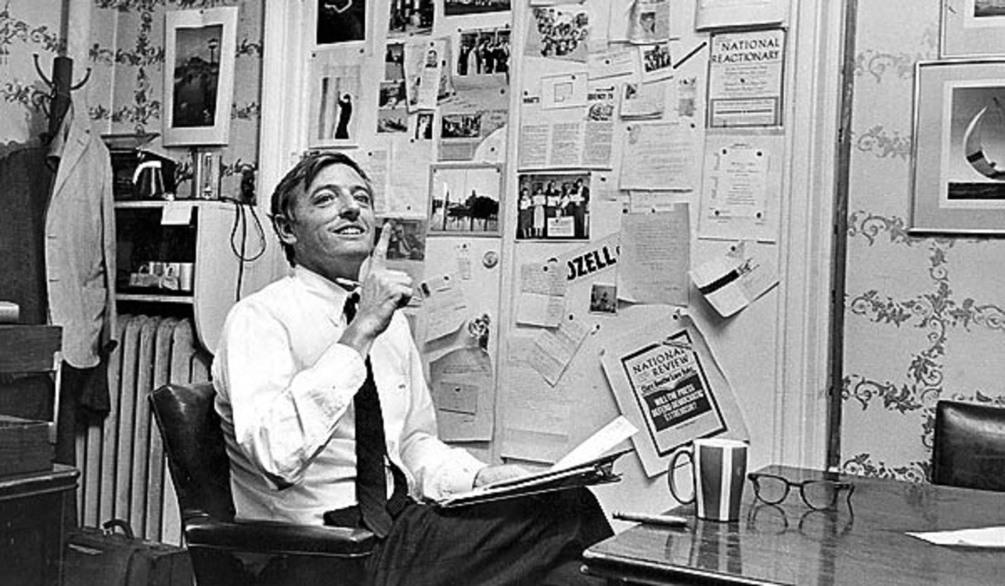
Still, while gaining repute for fighting antisemitism, Buckley’s role as the gatekeeper of the postwar conservative movement was initially cemented not by his campaign against antisemitism but by the campaign he launched against The John Birch Society and its founder, Robert Welch. What forced Buckley’s hand was Welch’s conspiratorial insistence that policy failures proved “communist” control at the top, including insinuations about Dwight D. Eisenhower.
In March 1961, Buckley warned Senator Barry Goldwater, at the time the leading figure in the conservative movement, that Welch was “nuts” and would do the cause “much damage.” Then followed an editorial, “The Uproar,” arguing that Welch’s “mistaken conclusions” were being used to “anathematize the entire American right wing.” Buckley faulted Welch’s method of inferring “subjective intention” from “objective consequences.”[28]
The escalation came in 1962 with the article “The Question of Robert Welch,” after a conservative “summit” discussion of effectively “excommunicating” Welch. Buckley pressed for what he called a “clean break,” urged readers – “out of a love of truth and country” – to reject Welch’s “false counsels,” and even solicited a supportive note from Ronald Reagan as he braced for the backlash.
That backlash was real: lost donors, bleeding subscribers, and a flood of angry mail. Yet Buckley kept pushing, and by 1965, he extended the critique from Welch to his Society as a whole, denouncing its premises as “paranoid and unpatriotic drivel” and arguing that until members demanded leadership that didn’t attribute everything to communist agents, they forfeited the right to complain about misrepresentation.
***
Buckley’s fight for drawing borders of legitimacy reached another peak following his retirement in 1990 from editing the gatekeeper he had founded. The focus of the fight was antisemitism and its new and sophisticated faces.
The conservative movement was struggling over journalist Joseph Sobran (1946-2010), a gifted polemicist who was once Buckley’s protégé, and Patrick Buchanan (b. 1938), the dissenting Republican speechwriter and senior media advisor. The two paleoconservatives spoke for isolationism, so-called Christian family values, protectionism, and limiting migration. They turned foreign policy disputes over the First Gulf War into stories about betrayal, sovereignty, and the Israel lobby.
The fight was never only about tone, or even about taboo. It was about whether the movement would allow itself a particular view that sees politics as hidden Jewish control to become a respectable way of talking about power.
Sobran’s move was to offer conservatives a vocabulary that made resentment sound like courage. He insisted that he did not seek a “negative outcome” for Jews and that his crusade was “to bring Jews down to the level of ordinary civil society.”[29] His technique was not subtle. In a nutshell, he tried to convince that Jewish outrage becomes proof of Jewish power, and that the act of naming antisemitism becomes its own kind of coercion.
Later flirtations with Holocaust denial were not a separate scandal but a continuation of the same posture. When criticized for speaking to the Institute for Historical Review, the California-based organization that promotes Holocaust denial and antisemitic views through its “historical revisionist approach,” Sobran brushed aside the warning embedded in the invitation itself: “I wasn’t just speaking to ‘Holocaust deniers,’ but also to Holocaust believers.”[30] The sentence performs a familiar laundering operation by turning denial into a mere “side” in a debate, and skepticism into professional bravery.
As journalist Jeffrey Goldberg later summarized, Sobran grew comfortable with a “Holocaust agnostic” stance. He did not deny Jewish suffering in general, but publicly “wondered” about genocide as Nazi policy and suspected that the numbers were “exaggerated.”[31] In a movement struggling to police its borders, “agnosticism” functions the way “just asking questions” functions today among demagogues. It preserves the insinuation while disowning responsibility for its consequences.
Sobran offered a defensive theory that had aged into a template for contemporary right-wing discourse. “Jewish claims are being cut down to size,” he said. While Jews “code” this downsizing as antisemitism, “I don’t think it is. It’s more like counter-Semitism.”[32] He insisted “counter-Semitism” did not seek a “negative outcome” for Jews; rather, it sought to diminish “the excessive moral prestige Jews have in the media and the public square […] Jews deciding the standards, setting the criteria of humanity.”[33]
Sobran was offering conservatives a way to resent Jews as a class without claiming to hate them. Once Jews are framed as a moral aristocracy, an elite that “sets the criteria of humanity,” the movement can justify hostility as a democratic corrective rather than prejudice.
As Sobran, Buchanan mastered the fusing of domestic grievance and foreign policy skepticism into a narrative of national betrayal. The infamous Buchanan phrases that Congress is “Israeli-occupied territory,” with the Israeli Defense Ministry and its “amen corner” beating the drums for war, worked as rhetorical bombs because they were not merely arguments. They were insinuations about control.
In December 1991, Buckley published his long National Review essay “In Search of Antisemitism,” later expanded into a book with responses.[34] He concluded that Sobran and Buchanan, who had just announced his candidacy for the Republican presidential nomination, had made “antisemitic statements, even though they are not antisemites.”[35]
That formulation, antisemitic statements without antisemitic identity, was Buckley’s attempt to impose a boundary while preserving, insofar as possible, a charitable reading of motives. Yet it also exposed a fundamental weakness in the conservative movement’s ability to police antisemitism. When one defines antisemitism as an interior state of hatred, one gives oneself endless room to rationalize rhetoric that activates old tropes. On the other hand, doing so allows the enforcement of a boundary without pretending to read souls.
Norman Podhoretz, the Jewish editor of Commentary and a founding father of neo-conservatism, treated Buckley’s fine-line drawing as both admirable and dangerously insufficient. Podhoretz opened his letter with a mixture of content and accusation. He wrote that he was relieved Buckley’s essay did not confirm his “deepest apprehensions,” but confessed he had feared Buckley “just didn’t get it.”
Podhoretz mocked the idea that one could hold a conference on “Whither Incest?” merely to reaffirm the incest taboo; if you have to go searching for antisemitism, he implied, you may be tempted to conclude it isn’t there.[36] His larger point was that antisemitism often lives precisely in the denial that it exists. Especially so when dressed up as policy realism.
***
By 1992, as Buchanan gained momentum in his campaign for the Republican Presidential nomination (In February, he won 37.5% in the New Hampshire primary against the incumbent President, George H.W. Bush), commentators grappled with how his phrasing sounded to Jewish listeners. On PBS, Jim Lehrer, the iconic host and a symbol of non-partisanship, quoted Buckley’s interpretation of Buchanan’s “amen corner” line, noting: “There is no way to read that sentence without concluding that Pat Buchanan was suggesting that American Jews manage to avoid personal military exposure even while advancing military policies they uniquely engineered.”[37]
The paleoconservatives fought back. Their mouthpiece Chronicles responded to Buckley’s anti-antisemitism campaign by construing the debate itself as a Jewish plot. For them, it was “another way of saying: ‘We and our friends are not antisemitic, and anybody who says otherwise is a tool of the Jewish conspiracy.’”[38] In this manipulative framing, the accusation of antisemitism became evidence of Jewish manipulation. The typical vicious circle of conspiracy theories is that disproving them is proving them.
Paul Berman’s portrait of the conservative debate in his review of In Search of Antisemitism captured the central difficulty: “Antisemitism is nearly impossible to debate” because few admit to harboring it, definitions are contested, and the argument bogs down into “7ou are so,” “I am not,” and complaints about bullying.[39]
Buckley did not kick out the kooks in the 1990s as some would like to believe. Not entirely. Yet the aspiration mattered. The conservative movement’s legitimacy depended on persuading people “to our immediate left” that conservatism was not a paranoid menagerie.[40]
What makes the Tucker Carlson moment so haunting is that it looks like a movement returning to the same moral problem under conditions that make the old remedy – editorial discipline – harder to apply. If Buckley’s model was purity, Heritage Foundation Roberts’s model is coalition unity at almost any cost.
The difference between the models is that between Reaganism and Trumpism. The former conservative coalition believed that there are limits to what may be done in order to gain power, and carried 49 states. The latter conservative coalition hardly recognized the existence of red lines at all, and bitterly divided America. Sobran’s “outspoken antipathy to Israel” and his belief in the “undue influence of a Jewish lobby on US foreign policy” led to his removal from National Review in 1993.[41] It is hard to imagine a leading conservative voice removed from anything today, for anything.
The present argument in the conservative movement about Carlson repeats the structure of defense promoted by Sobran almost perfectly, down to the complaint that naming antisemitism is itself persecution. The difference is that Carlson is not a columnist dependent on a masthead; he is a media ecosystem unto himself.
When Buckley tried to restore order, one commentator joked, he “circles overhead […] dropping fire retardant. But it’s no use.”[42] Today, there’s no one circling over Carlson’s head; he’s dependent on no one, just his audience and an internet connection. In this media age, being outrageous is not a liability but a means to become more powerful and richer.
Writing in Commentary, Christine Rosen framed the Fuentes episode not as a miscommunication but as a performance of indulgence. She described Fuentes “complaining about ‘organized Jewry’ and the Jews ‘controlling the media apparatus,’” while Carlson – “smiling and nodding along” – offered only a tactical objection that “going on about the Jews helps the neocons.”[43] In The Free Press, Eli Lake reached for a Buckley-ish distinction between tolerating speech and welcoming the speaker, warning that “defending the rights of neo-Nazis to bear memes on the internet is not the same as inviting those bigots into the GOP’s big tent.”[44]
The very need to restate these distinctions is the proof of how little purchase they now have. National Review can still call the Carlson show a “vehicle” for “laundering noxious ideas into the conservative mainstream,”[45] yet it cannot fire him. The Dispatch can argue with him, but it cannot de-platform him. Commentary can diagnose the sickness, but it cannot isolate the sick. The new right is not organized around a small set of institutions capable of enforcing reputational penalties; it is organized around audience capture and algorithmic reward.
Antisemitism, once confined to newsletters and crank presses, now “lives and thrives” on “entertainment platforms,” where figures like Fuentes and Carlson can monetize transgression at scale.[46] The “contrarianism” that once required editors and networks now moves through a post-network distribution system – portable, independent, and insulated from the old forms of discipline.[47] Buckley’s heirs are still speaking; the problem is that the movement no longer has to listen.
This is why the Heritage Foundation debate matters as more than a personality feud. It marks a moment when an institution that once functioned as a gatekeeper chose, at least initially, not to enforce the boundary, rejecting Buckley’s idea that the movement had any obligation to police its own boundaries. In 1990, Buckley had taken pride in excluding “anything antisemitic or kooky.” In 2025, Roberts defended a host accused by fellow conservatives of “normalizing Nazism.”
The backlash to Kevin Roberts illuminated how fragmented the right has become. The American-Jewish and vocal pro-Israel media author and podcaster Ben Shapiro devoted an entire show to denouncing Carlson and Fuentes.[48] “That splinter faction is now being facilitated and normalized within the mainstream Republican Party,” Shapiro said. “The main agent in that normalization is Tucker Carlson.” He called Carlson “an intellectual coward” and “an ideological launderer for other people’s evils,” and accused Heritage of betraying “[its] history and principles.”[49]
Shapiro’s language echoes Buckley’s older fear that if the movement cannot expel extremists, it will be defined by them. He ended with a sentence that reads like a rejection of the “no enemies to the right” manifesto: “These people have already declared themselves to be my enemies. I’d be a fool not to take them seriously.”[50]
Cruz’s language, too, was boundary-enforcement rhetoric: not merely “this is wrong,” but “if you sit there and say nothing, you are complicit.”[51] The important contribution of both Shapiro and Cruz is that they were trying to revive something like the Buckley norm in a media environment that eschews and punishes such policing and, in any case, makes them almost futile.
Indeed, Carlson’s defenders forcefully treat condemnation as proof of persecution. Fuentes himself responded to the controversy with a statement that could have been written by the most embittered paleoconservatives of the 1990s, updated for the meme age: “We are done with the Jewish oligarchy […] the policing of antisemitism, the Holocaust religion and propaganda.”[52] This is Sobran’s “counter-Semitism” logic stripped of its respectable prose. It is the open declaration that accusations directed at antisemites are not warnings about prejudice but tools of oppression to be resisted.
***
When Roberts said Heritage would not “start […] policing the consciences of Christians,” he was not only defending Carlson. He was announcing that disciplining Carlson or others had become politically dangerous.[53] The reasons for that danger are foremost demographic.
Describing the Carlson-Fuentes fallout, conservative writer Rod Dreher suggested he’d been told that 30% to 40% of Republican staffers under 30 are “Groypers” (the movement of fans, followers, or supporters of Fuentes), and that Fuentes’ turning the GOP into a truly reactionary party was a vision “coming true.”[54]
The almost 3,000 pages of leaked Telegram messages among Young Republicans were not simply politically incorrect; they were a cesspool of hate, a vile demonstration of the ever-eroding boundaries of decency and humanity online. One participant, in a line that condensed the moral collapse into three words, wrote: “I love Hitler.”[55] Another, anticipating precisely the kind of exposure that later arrived, warned: “If we ever had a leak of this chat, we would be cooked fr fr [“for real” in internet slang].”[56]
The deeper significance is not that young activists sometimes talk like this, but that they talked like this as a political identity, and then treated as scandal the discovery, not the speech. Buckley’s argument about “kookery” was never only about belief. It was about governance. A movement cannot claim seriousness while its next generation treats Nazism as a punchline, gas chambers as a political threat, and racial contempt as the price of belonging to the in-group.
***
The Sobran and Buchanan controversies were, in part, battles over the meaning of inference. Sobran wanted conservatives to believe Jewish outrage proved Jewish power. Buchanan wanted conservatives to believe that talk of “amen corners” and “occupied territory” was nothing more than political realism. In response, Buckley wanted conservatives to recognize that old tropes did not disappear merely because the speakers insisted they had no hatred in their hearts. The movement’s tragedy is that Buckley’s fine-line drawing, while morally earnest, may have inadvertently trained conservatives to treat antisemitism as a matter of endlessly contestable definitions – an invitation, in the social media era, to permanent paralysis.
Berman captured this danger in a New Yorker review with an almost throwaway observation: “Section by section, the greater weight of [Buckley’s] indignation falls upon the anti-antisemites.”[57] That is the hinge on which the conservative movement’s argument turns: how much energy is spent condemning antisemitism, and how much energy is spent condemning those who point it out. In the Carlson era, that ratio has shifted dramatically. Kevin Roberts’s defense of Carlson was, in effect, an attack on the anti-antisemitism faction. The “venomous coalition” was not Fuentes’ audience; it was those who insisted Fuentes should not be normalized.[58]
The question is whether the conservative movement can still move “up” from this – whether it can still treat the exclusion of the antisemitic and the conspiratorial as a precondition of respectability. In 1990, Buckley believed that the “absolute exclusion” of the antisemitic and “kooky” was an achievement worth claiming as the movement’s greatest success.[59] Thirty-five years later, a major conservative institution briefly defended a host who normalized a neo-Nazi, and it did so in the language of coalition unity.[60]
***
After Carlson was fired from Fox News in 2023, he “often gave voice to incendiary views that were not substantively different from Fuentes’ own – especially as they pertained to Israel and prominent Jewish figures.”[61] Apparently, he concluded that he “could not afford to alienate the Groypers,” so he extended an olive branch to Fuentes in the form of the podcast-interview request.[62]
Carlson’s June 2025 interview with Ted Cruz, an episode that served as a prelude to the Fuentes controversy, illustrates how the “America First” argument can take an antisemitic turn.[63] In the viral episode (over 4.5 million views on YouTube alone), Carlson pressed Cruz on his ties to the American Israel Public Affairs Committee (AIPAC), asking whether the pro-Israel lobbying group founded in 1954 should register under the Foreign Agents Registration Act (FARA). Carlson stated, “I don’t understand why we don’t just be honest and say they’re lobbying on behalf of [a] foreign government.” Cruz replied, “That is not only not true – that is false.”[64]
Americans have long debated lobby and special interest influence. But it becomes difficult to separate the debate from the movement’s antisemitism problem because it closely resembles the structure Buckley and his contemporaries were trying to stigmatize in the 1990s: the insinuation that Israel and its domestic allies exercise a uniquely corrupt form of power over American sovereignty. Current legal interpretations of the FARA statute clarify that AIPAC does not need to register as a foreign agent, making the charge more rhetorical and symbolic than something with legal merit and weight.[65]
The insinuations in the interview became explicit enough to trigger the old conservative alarm bells in Cruz. When Carlson framed Cruz’s defense of AIPAC as “foreign influence,” Cruz responded with a sentence that reads like a distilled version of Buckley-era anxiety: “By the way, Tucker, it’s a very weird thing, the obsession with Israel,” prompting the host to snap: “Oh, so I’m an antisemite now?”[66]
What followed was an unhinged volley of outright contempt. “Shame on you,” Carlson seethed. “You’re implying it in a sleazy feline way.” Cruz pointed to Carlson’s relentless focus: “You’re not talking about the Chinese, the Japanese, the Brits…you’re asking: ‘What about the Jews? What about the Jews?’” Carlson responded that he doesn’t “even like talking about Israel” because it inevitably leads to charges of antisemitism.[67]
The line is revealing because it treats Carlson’s posture not as an ordinary policy dispute but as a fixation – precisely the category Buckley used when he suggested that certain writers, such as Sobran, had developed a rhetorical obsession with Jews and Israel that turned ordinary criticism into contextual antisemitism.
Carlson’s defenders often present this fixation as a principled foreign-policy realism: why should America be dragged into Middle East wars; why should Washington treat Israel’s priorities as America’s; why should a lobby be immune from scrutiny? This was exactly Buchanan’s self-description in the 1990s. Yet when one repeatedly frames American Middle East policy as the product of a foreign state’s domestic servants – an “amen corner,” an “occupied territory,” a lobby that supposedly operates as a foreign agent – one not only criticizes policy, which is completely legitimate and necessary in a healthy democratic society. Rather, one is educating one’s audience to interpret power through a conspiratorial template in which Jews become the explanatory key.
In Las Vegas, Cruz told the RJC summit that “in the last six months” he has seen “more antisemitism on the right” than in his entire life.[68] This is an extraordinary claim from a Republican senator with presidential aspirations who built a national profile partly by attacking antisemitism on the left. It functions as a movement-level warning: the old conservative habit of locating antisemitism primarily on the left and in progressive spaces is no longer sufficient, because the right’s own ecosystem is now producing – and monetizing – antisemitic patterns.
The Carlson anti-Israel rhetoric is not always directed at Israel as a state; often, it is directed at the moral status Israel occupies in conservative identity. Carlson’s line – “I’m from here” – in his criticism of Shapiro and other pro-Israel conservatives, functions as a nationalist litmus test: what kind of American prioritizes a foreign conflict while America is “dangerously unstable”?[69] This line resembles Buchanan’s older nationalist framing, but it becomes combustible when it slides into the older insinuation that Jewish Americans prioritize Israel over the United States. That is the dual-loyalty trope in updated clothes.
Carlson’s challenge and criticism of Israel’s status in conservative identity show few signs of dissipating. They are situated today more than ever at the center of the debate over America’s foreign policy, at a time when more Americans sympathize with the Palestinian than with Israel and its cause appears almost lost among Democrats and is alarmingly losing support also among Republicans, in particular young ones.
Sadly, the language of conspirators finds, repeatedly, careless and inadvertent helpers among friends of Israel. Just a week before the American-Israeli war against Iran began, US Ambassador to Israel Mike Huckabee initiated an interview to Carlson. The disaster could not have been graver.
The ambassador essentially proved his interlocutor’s point that Christian Zionism is a doctrine that distorts conservative foreign policy judgment when he claimed he would be fine with Israel taking over all the territory “from the Nile to the Euphrates” in fulfillment of its biblical mandate. Openly contradicting the Trump Administration’s official policy, Huckabee set off a diplomatic firestorm and sparked a wave of condemnations.[70] Carlson himself could not have done a better job of damaging Israel at a sensitive moment.
***
If the Republicans cannot say no to media personalities whose worldview begins with the claim that Jews are running society or who openly admire Hitler and deny the Holocaust, they will eventually lose the capacity to say no to anything. That is the problem with the habit of indulgence: It becomes a habit.
The conservative movement today does not merely face an antisemitism “problem.” It faces a moral crisis and a leadership vacuum. It urgently needs a new William F. Buckley Jr. New Media will make the task of that new Buckley daunting. Yet new media are not the only hindrance. True soul searching and reform on the American right will likely have to wait for a post-Trump era, when and if truth, honor, God-fearing, and other values that once made America great reemerge as strong conservative political currencies.
- Dr. Carl Yonker
[1] Joseph Ax, Brad Brooks, and Andrea Shalal “Conservative Influencer Charlie Kirk Shot Dead, Manhunt Launched for Suspect,” Reuters, September 11, 2025, https://www.reuters.com/world/us/conservative-influencer-charlie-kirk-shot-dead-manhunt-suspect-2025-09-11/.
[2] Anti-Defamation League, “Antisemitic and Anti-Israel Conspiracy Theories Follow Fatal Shooting of Charlie Kirk,” September 2025, https://www.adl.org/node/93251; Mathilda Heller, “Antisemitic Posts Spike after Kirk Killing, Israel Blamed,” The Jerusalem Post, September 14, 2025, https://www.jpost.com/diaspora/antisemitism/article-867435; and Counter Extremism Project, “Eye on Extremism: September 15, 2025,” September 15, 2025, https://www.counterextremism.com/roundup/eye-extremism-september-15-2025.
[3] Hatewatch Staff, “Antisemitic Conspiracy Theories Claim Israel, Mossad to Blame for Kirk Killing,” Southern Poverty Law Center, October 28, 2025, https://www.splcenter.org/resources/hatewatch/charlie-kirk-antisemitic-conspiracy-theories/.
[4] Candace Owens, “Charlie Kirk Shooting Suspect Charged. Something Isn’t Right… | Candace Ep 236,” YouTube, September 17, 2025, https://www.youtube.com/watch?v=q7f8r-THr84; Candace Owens, “Who Ordered the Hit on Charlie Kirk? | Candace Ep 237,” YouTube, September 18, 2025, https://www.youtube.com/watch?v=2WEHTk0Xewg; and Sam Wolfson, “Rightwing Podcasters Run Rampant with Charlie Kirk Conspiracies: ‘It’s Craven Opportunism,’” The Guardian, September 24, 2025, https://www.theguardian.com/us-news/2025/sep/24/charlie-kirk-conspiracies-rightwing-podcasters.
[5] Candace Owens, “Who Ordered the Hit on Charlie Kirk?”
[6] Tucker Carlson, “Full Speech: Tucker’s Charlie Kirk Memorial…,” YouTube, September 22, 2025, https://www.youtube.com/watch?v=zfI-JZEBNss.
[7] Ben Shapiro, “Tucker Carlson Sabotages America,” YouTube, November 3, 2025, https://www.youtube.com/watch?v=OaRJlL5mOF8.
[8] Jason Beeferman and Emily Ngo, “‘I Love Hitler’: Leaked Messages Expose Young Republicans Racist Chats,” Politico, October 14, 2025, https://www.politico.com/news/2025/10/14/private-chat-among-young-gop-club-members-00592146.
[9] Marina Dubnar, “US Capitol Police Investigating Flag with Swastika in Republican Representative’s Office – Report,” The Guardian, October 15, 2025, https://www.theguardian.com/us-news/2025/oct/15/capitol-us-flag-swastika-republican-dave-taylor.
[10] CNN, “Vance Downplays Leaked Racist GOP Texts: ‘Kids Do Stupid Things,’” YouTube, October 16, 2025, https://www.youtube.com/watch?v=s0tiFfkp1q8.
[11] Carl Yonker, “The United States: Far Right and Wrong,” in Antisemitism Worldwide Report for 2023 (Tel Aviv University – The Center for the Study of Contemporary European Jewry and the Irwin Cotler Institute for Democracy, Human Rights and Justice, 2024), pp. 38-39, https://cst.tau.ac.il/wp-content/uploads/2025/04/AntisemitismWorldwide_2023.pdf.
[12] Michelle Goldberg, “Nick Fuentes was Charlie Kirk’s Bitter Enemy. Now He’s Become His Successor,” New York Times, November 3, 2025, https://www.nytimes.com/2025/11/03/opinion/nick-fuentes-kirk-successor.html, and William Oremus, “Far-Right Provocateur Nick Fuentes is Triggering a MAGA Civil War,” The Washington Post, November 8, 2025, https://www.washingtonpost.com/technology/2025/11/08/nick-fuentes-tucker-carlson-hate-speech/. For the original recording: Nicholas J. Fuentes, “Andrew Tate’s Persecution PROVES Women are OUT OF CONTROL,” Rumble, March 28, 2025, https://rumble.com/v6rds6a-andrew-tates-persecution-proves-women-are-out-of-control.html?e9s=src_v1_ucp_v.
[13] Kevin Roberts (@KevinRobertsTX), “There has been Speculation…,” X, October 30, 2025, https://x.com/KevinRobertsTX/status/1983958755613262324; Rachel Leingang, “Tucker Carlson’s Interview with Far-Right Antisemite Nick Fuentes Divides Conservatives,” The Guardian, October 31, 2025, https://www.theguardian.com/us-news/2025/oct/31/conservative-reaction-tucker-carlson-nick-fuentes-interview; and Caitlin Yilek and Fin Daniel Gómez, “Backlash Erupts at Heritage Foundation after Leader Defends Tucker Carlson’s Interview with White Nationalist Nick Fuentes,” CBS News, November 7, 2025, https://www.cbsnews.com/news/heritage-foundation-kevin-roberts-tucker-carlson-interview-nick-fuentes/.
[14] Jonathan D. Salant, “‘Cleary Have Antisemitism Element of Our Party,’ McCormick Says at RJC,” JNS, November 2, 2025, https://www.jns.org/clearly-have-antisemitism-element-of-our-party-mccormick-says-at-rjc/.
[15] Newsmax, “Republicans are Unafraid to Call Out Far-Right Fringe Antisemitism: RJC Spokesman | National Report,” YouTube, November 3, 2025, https://www.youtube.com/watch?v=O9FQ_pcKKAw.
[16] The Economic Times, “‘Tucker is not MAGA’: Furious GOP Lawmakers Label Carlson an ‘Antisemite’ over Anti-Israel Stance,” YouTube, November 4, 2025, https://www.youtube.com/watch?v=LlX93ZhG2Nk.
[17] Republican Jewish Coalition and Ted Cruz, “Ted Cruz’s Passionate Defense of the American Jewish Community, Calling Out Antisemitism,” YouTube, October 31, 2025, https://www.youtube.com/watch?v=2AqNraNbiOQ. See also: Samuel Benson, “Ted Cruz Accuses GOP Senators of Being ‘Frightened’ to Call Out Tucker Carlson,” Politico, November 7, 2025, https://www.politico.com/news/2025/11/07/ted-cruz-accuses-gop-senators-tucker-carlson-00642198.
[18] Carlson, “Tucker Carlson Interviews Nick Fuentes.”
[19] Tucker Carlson, “Ted Cruz Uses the Bible to Justify Israel Support,” YouTube, June 18, 2025, https://youtube.com/shorts/4YgM2dswgdw?si=5WhXe8W0YXvdPtFf.
[20] Meredith Lee Hill, “McConnell Pans Heritage Foundation for Its Defense of Tucker Carlson’s Nick Fuentes Interview,” Politico, October 31, 2025, https://www.politico.com/news/2025/10/31/mcconnell-heritage-foundation-tucker-carlson-00631510.
[21] Olivia Beavers, “Johnson: Carlson Interview with Fuentes was a ‘Big Mistake,’” Politico, November 25, 2025, https://www.politico.com/news/2025/11/25/mike-johnson-tucker-carlson-nick-fuentes-interview-00668135.
[22] Ambassador Mike Huckabee (@GovMikeHuckabee), “Giving a Platform…,” X, October 31, 2025, https://x.com/govmikehuckabee/status/1984355974832894149?s=46&t=_PvZCal4UXyjdpDdKxuF0A; Theodoric Meyer, “Tucker Carlson’s Interview with White Nationalist Triggers GOP Backlash,” The Washington Post, October 31, 2025, https://www.washingtonpost.com/politics/2025/10/31/carlson-fuentes-heritage-antisemitism/, and The Editors, “A Time for Choosing on Antisemitism,” National Review, October 30, 2025, https://www.nationalreview.com/2025/10/a-time-for-choosing-on-antisemitism/.
[23] Matthew Continetti, “Up from Kookery,” National Review, December 19, 2024, https://www.nationalreview.com/magazine/2025/02/up-from-kookery/.
[24] William F. Buckley, Jr., In Search of Antisemitism (New York: Continuum, 1992), pp. 5-6.
[25] “The Press: Blowup at the Mercury,” Time, October 10, 1955, https://time.com/archive/6610049/the-press-blowup-at-the-mercury/, and Vincent Fitzpatrick, “The American Mercury,” Menckeniana no. 123 (Fall 1992), pp. 1-6.
[26] Matthew Walsh, Taking America Back: The Conservative Movement and the Far Right (Yale University Press, 2024), p. 148.
[27] Ibid., pp. 148-150, and Norman Podhoretz, “What Is Antisemitism? An Open Letter to William F. Buckley, Jr.,” Commentary, February 1992, https://www.commentary.org/articles/norman-podhoretz/what-is-anti-semitism-an-open-letter-to-william-f-buckley-jr/.
[28] Alvin S. Felzenberg, “The Inside Story of William F. Buckley Jr.’s Crusade against the John Birch Society,” National Review, June 20, 2017, https://www.nationalreview.com/2017/06/william-f-buckley-john-birch-society-history-conflict-robert-welch/.
[29] Jacob Weisberg, “The Heresies of Pat Buchanan,” The New Republic, October 22, 1990, https://newrepublic.com/article/69035/the-heresies-pat-buchanan.
[30] Joseph Sobran, “For Fear of the Jews,” IHR – Institute for Historical Review, June 22, 2022, https://ihr.org/journal/v21n3p12_sobran-html.
[31] Jeffrey Goldberg, “The Death of a ‘Holocaust Skeptic,’” The Atlantic, October 12, 2010, https://www.theatlantic.com/politics/archive/2010/10/the-death-of-a-holocaust-skeptic/64130/.
[32] Weisberg, “The Heresies of Pat Buchanan.”
[33] Ibid.
[34] See, Buckley, Jr., In Search of Antisemitism.
[35] The Editors, “Editorial: Christians, Jews, and Antisemitism,” First Things, March 1, 1992, https://firstthings.com/editorial-christians-jews-and-anti-semitism/, and The Editors, “Editorial: The Year that Conservatism Turned Ugly,” First Things, May 1, 1992, https://firstthings.com/editorial-the-year-that-conservatism-turned-ugly/.
[36] Podhoretz, “What Is Antisemitism?”
[37] “Israel and Its ‘Amen Corner,’” Washington Report on Middle East Affairs, February 1992, https://www.wrmea.org/1992-february/what-they-said-israel-and-its-amen-corner.html.
[38] “Editorial: The Year that Conservatism Turned Ugly,” First Things, May 1, 1992, https://firstthings.com/editorial-the-year-that-conservatism-turned-ugly/.
[39] Paul Berman, “Gentlemen’s Disagreement,” The New Yorker, October 12, 1992, https://www.newyorker.com/magazine/1992/10/12/1992-10-12-114-tny-cards-000148476.
[40] Ibid.
[41] William Grimes, “Joseph Sobran, 64, Writer Whom Buckley Mentored,” New York Times, October 1, 2010, https://www.nytimes.com/2010/10/02/books/02sobran.html.
[42] Berman, “Gentlemen’s Disagreement.”
[43] Christine Rosen, “Hating Jews for Fun and Profit,” Commentary, December 2025, https://www.commentary.org/articles/christine-rosen/antisemitism-entertainment-carlson/.
[44] Eli Lake, “The Meltdown at Heritage—and the Fight for MAGA’s Future,” The Free Press, November 3, 2025, https://www.thefp.com/p/the-meltdown-at-heritage-tucker-carlson-nick-fuentes.
[45] Rich Lowry, “Tucker Carlson Outdoes Himself,” National Review, November 4, 2025, https://www.nationalreview.com/2025/11/tucker-carlson-outdoes-himself/.
[46] Rosen, “Hating Jews for Fun and Profit.”
[47] Jason Zengerle, “Tucker Carlson’s Nationalist Crusade,” The New Yorker, February 2, 2026, https://www.newyorker.com/magazine/2026/02/02/tucker-carlsons-nationalist-crusade.
[48] Ben Shapiro, “Tucker Carlson Sabotages America.”
[49] Ibid.
[50] Ibid.
[51] Leingang, “Tucker Carlson’s Interview.”
[52] Nicholas J. Fuentes, “Recapping My Interview with Tucker Carlson,” Rumble, October 29, 2025, https://rumble.com/v70y9cm-recapping-my-interview-with-tucker-carlson.html?e9s=src_v1_ucp_v.
[53] Yilek and Gómez, “Backlash Erupts at Heritage Foundation.”
[54] “The GOP: Will It Welcome Antisemites?” The Week, November 10, 2025, https://theweek.com/politics/gop-welcome-antisemites-tucker-carlson-nick-fuentes.
[55] Ibid.
[56] Ibid.
[57] Berman, “Gentlemen’s Disagreement.”
[58] Magid, “US Jewish Groups Bail.”
[59] Burchard, “Buckley Retires as Editor.”
[60] Yilek and Gómez, “Backlash Erupts at Heritage Foundation.”
[61] Zengerle, “Tucker Carlson’s Nationalist Crusade.
[62] Ibid.
[63] Carl Yonker, “Tucker and the Jews,” Perspectives no. 43 (Tel Aviv University – The Center for the Study of Contemporary European Jewry, June 2025), https://cst.tau.ac.il/perspectives/tucker-and-the-jews/.
[64] Tucker Carlson, “Tucker Confronts Ted Cruz on His Support for Regime Change in Iran,” YouTube, June 18, 2025, https://www.youtube.com/watch?v=smemFVe0l5E.
[65] Hannah Feuer, “Tucker Carlson and Ted Cruz’s Obscure Legal Debate about AIPAC, Explained,” The Forward, June 19, 2025, https://forward.com/news/730423/tucker-carlson-ted-cruz-aipac-foreign-agent/.
[66] Tucker Carlson, “Tucker Confronts Ted Cruz.”
[67] Ibid.
[68] Nicholas Riccardi, Jill Colvin, and Thomas Beaumont, “Controversy Over Tucker Carlson Interview Reveals Conservative Establishment’s Conflict Over Antisemitism,” YahooNews, October 31, 2025, https://www.yahoo.com/news/articles/heritage-foundation-head-defends-tucker-071353260.html.
[69] Ibid.
[70] Tucker Carlson, “Tucker Confronts Mike Huckabee on America’s Toxic Relationship with Israel,” YouTube, February 20, 2026, https://www.youtube.com/watch?v=XS7itdfgNnU, and Maia Davies, “US Ambassador’s Israel Comments Condemned by Arab and Muslim States,” BBC, February 22, 2026, https://www.bbc.com/news/articles/cn5gkkgdzkyo.