
The Fortress
Reflections on Berlin's New Synagogue
Carl Yonker
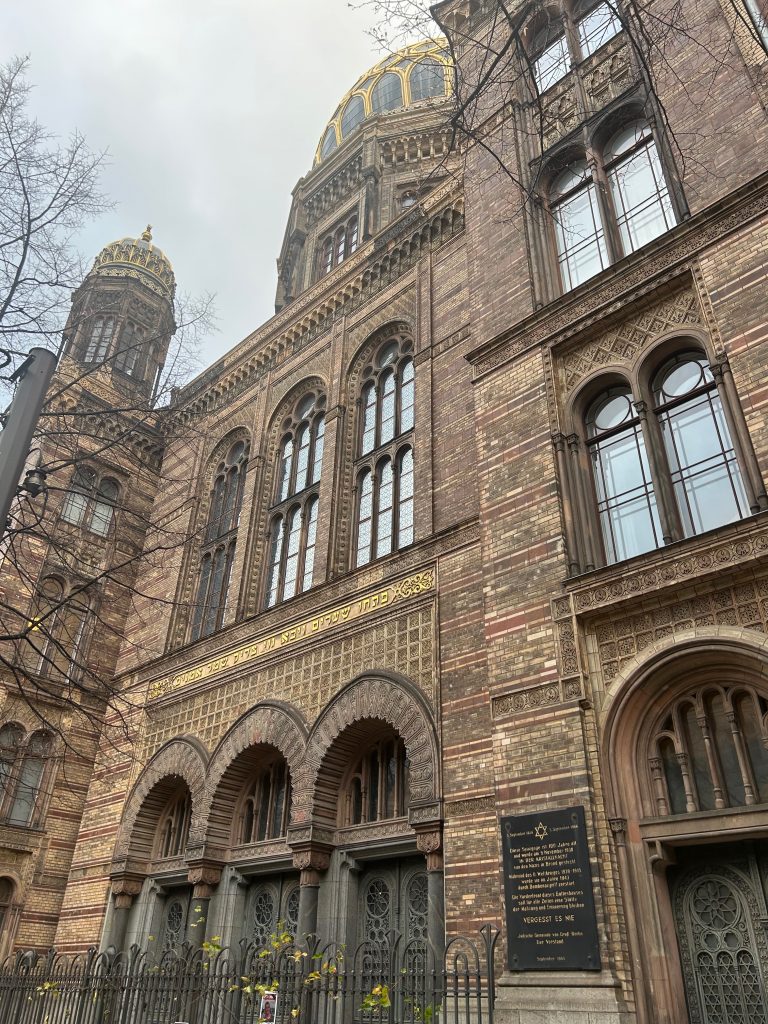
On most afternoons, Oranienburger Straße is busy with pedestrian foot traffic. The low murmur of café chatter is punctuated by the rumble of the tram. Above the street, the gilded ribs of the New Synagogue’s (Neue Synagoge) central dome catch the light. They hover over what was once the heart of Jewish Berlin.
At ground level, the view is less serene. Concrete bollards, reinforced guard rails, security cameras, and armed police officers frame the entrance.
When it first opened in 1866, the New Synagogue was conceived as the architectural declaration of a confident, integrated community. Designed in a Moorish Revival style by Eduard Knoblauch and completed by Friedrich August Stüler, it drew direct inspiration from the Islamic architecture of the Alhambra.
With some 3,000 seats, it was the largest synagogue in Germany, built to accommodate a rapidly growing Jewish population in Berlin that had outgrown the Old Synagogue (Alte Synagoge) on Rosenstraße in the city’s Marienviertel district. It signaled that Berlin’s Jews belonged at the city’s center, not its margins.
It was the first synagogue in Germany whose doors opened at street level and whose main entrance was on the street, not behind a front building or hidden in a courtyard.
The building’s interior life matched its outward ambition.
The New Synagogue was home to a liberal community with a choir and organ. Services reflected the aesthetic and theological confidence of nineteenth-century Reform Judaism. Concerts and lectures were held in the main hall, including an oft-cited 1930 performance in which Albert Einstein played the violin.
In these decades, the synagogue embodied a particular promise of German-Jewish modernity – that one could be both fully Jewish and fully German.
During the Kristallnacht, Nazi mobs broke into the building, desecrated Torah scrolls, smashed furniture, and set the interior ablaze. However, the synagogue was spared complete destruction. It continued to function and hold services until 1940. Smaller gatherings were held in adjacent offices until 1942. In November 1943, British air raids devastated central Berlin. The synagogue was hit and largely burned out, its vast prayer hall reduced to a charred shell.
What remained after 1945 was less a building than a wound in the cityscape. In Soviet-occupied East Berlin, where only a tiny, impoverished Jewish community survived or returned, restoring the bombed-out structure was beyond imagination and not in the regime’s interest.
In 1958, the East German authorities ordered the rear sections, including the main sanctuary, demolished due to the risk of collapse, leaving only the street-front portion as a kind of architectural skeleton.
For three decades, this ruin formed part of the muted landscape of divided Berlin. The GDR officially commemorated “victims of fascism” while downplaying specifically Jewish suffering. The surviving Jewish community in the East was small, aging, and politically constrained. The former grandeur of the New Synagogue, its golden dome removed, its hall erased, seemed to confirm that Jewish Berlin belonged irretrievably to the past.
Only in the late 1980s, amid a broader rethinking of historical memory and the approaching end of the Cold War, reconstruction began. From 1988 to 1993, the street-front sections were restored, including the façade, entrance, and dome. The prayer hall was never reconstructed, though. It has become a gravel-covered open area in which kids play between buildings, gazed upon from the restored synagogue entrance hall through floor-to-ceiling panels of glass.
The goal was not to resurrect the lost nineteenth-century interior but to create a hybrid site: part museum, part archive, part place of worship.
The restored complex was inaugurated in 1995 as the New Synagogue Berlin – Centrum Judaicum, an international center for research, remembrance, and education devoted to the history of Jewish life in the city. Its exhibitions map the arc from early settlement and emancipation through Weimar pluralism, Nazi annihilation, and postwar reconstruction, embedding the synagogue’s story within a longer narrative of Jewish life in the city.
The revival of the New Synagogue coincided with a broader, if fragile, renaissance of Jewish life in Berlin. Post-1989 immigration from the former Soviet Union, students and artists drawn to the reunited capital, and the emergence of new cultural and educational institutions have produced a Jewish presence far more visible than anyone in the 1950s could have imagined.
The Centrum Judaicum’s exhibitions and public programs, from historical shows to contemporary art and debates on antisemitism, situate the site not only as a memorial but as a forum in which Jewish Berlin speaks back to the city that once tried to erase it. On November 9, they celebrated 30 years of renewal.
Yet the building’s present is shaped as much by tension as by renewal.
In 2024, Germany witnessed 148 incidents of antisemitic violence compared to 151 in 2023 and 88 in 2022.
In Berlin, a synagogue and community center in the Mitte district was attacked with Molotov cocktails in October 2023, an incident that prompted condemnations from the German chancellor and renewed promises of protection.
The New Synagogue has not been spared tension. In August 2025, a man subject to a house ban tried to enter the building. When refused, he tore down an Israeli flag at a nearby memorial for hostages held by Hamas and threw it to the ground, an act now under investigation by state security for its likely political motivation.
The city’s synagogues and other Jewish sites are guarded around the clock. The sight of police officers standing outside the Centrum Judaicum became a permanent feature of Oranienburger Straße, as it did around the corner at the offices of the Central Council of Jews in Germany on Tucholskystraße.
For German Jewish leaders, this tightening ring of protection reflects a hard paradox. On the one hand, the German state has invested heavily in securing Jewish life, with police unions and federal officials framing the safeguarding of the community, its members, and its institutions as a core democratic obligation in light of the country’s history.
On the other hand, the very visibility of police, armed guards, barriers, and surveillance underscores how precarious that life remains.
While noting the vibrancy of Jewish life and community in Germany, local Jewish leaders I have recently met in Berlin expressed a sense of uncertainty. They acknowledged that they were caught off guard and were unprepared for what has transpired over the past two years.
Entering the New Synagogue today involves walking past armed police, bag checks, and reinforced doors. The building that symbolized Jewish belonging in Berlin, and then destruction, now signals, just as clearly, that the revival of Judaism in Germany is contested.
The dome still gleams, a restored fragment of nineteenth-century optimism.